Application of Second-Order Analysis in Steel Frame Structures
The steel frame structure is a common form of building structure. The pursuit of novel forms and the use of new materials make structural stability design more important, and traditional linear analysis can increasingly hardly meet the requirements of current steel structure design. At present, the steel structure design codes of many countries have incorporated second-order analysis theory as a key element, recommending the use of second-order nonlinear analysis design methods to replace the traditional linear analysis and the design method based on the effective length factor.
The traditional effective length design method has been phased out by multiple codes, including the European Steel Structure Code (Eurocode-3 2005), the American Steel Structure Code (LRFD 2010), and the Hong Kong Steel Structure Code (HKSC 2005), and has been replaced by the second-order nonlinear analysis method. The traditional design method requires classification of steel frame structures, and structures with an elastic critical factor smaller than a certain specific value cannot be designed using linear analysis, such as the European code (Eurocode-3 2005) which sets the value at 3, the British code BS5950 (2000) at 4, and the Hong Kong code (HKSC 2005) and the Australian code AS4100 (1995) at 5. However, the use of the elastic critical load is limited to regular building frame structures mainly subjected to gravity loads; many complex structures, such as large transmission towers, scaffolding, and spatial reticulated shell structures, cannot be measured by the elastic critical factor and therefore cannot be designed using linear analysis.
The second-order analysis method has become the preferred method for current steel structure design. The new edition of the American code (LRFD 2010) has moved the second-order analysis method to the core chapter while the linear analysis method has been placed in the appendix; the European code (Eurocode-3 2005) has also placed the second-order nonlinear analysis method ahead of the linear analysis method. Theoretically, the linear analysis method cannot account for the changes in stiffness of the structure and members under load, and therefore the internal force results obtained are inaccurate. Linear analysis assumes that all the stiffness of the structure comes from the materials used in the structure and the geometric characteristics of the structure, ignoring the effect of loads on the members, so that linear analysis shows no difference in the calculation results between tension members and compression members, whereas in practice, long-term experience has concluded that the load-carrying capacity of compression members is significantly lower than that of tension members. Therefore, the American code (LRFD 2010) requires the use of a reduction factor τb for stiffness reduction to compensate for the deficiencies of linear analysis. More importantly, the value of the effective length is uncertain, sometimes overestimated and sometimes underestimated. Current codes all try to avoid using the effective length method for structural stability design.
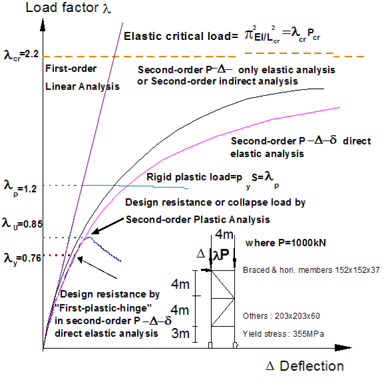
Chan and Gu (2000) described in detail in their paper the derivation process of the bending stability equation established according to the curvature in Table 5.1 of the European code (Eurocode-3 2005), and Liu, Chan and Lam (2011) applied this equation in the second-order analysis and design of semi-rigid frames. The figure below describes the load-deflection curves obtained using different analysis and design methods, and compares the ultimate load-carrying capacities obtained by these methods with the ultimate load-carrying capacity λu under the experimental failure condition. The article discusses in detail how to use the first plastic hinge method to obtain the load factor λy at which the first member in the structure fails, that is, when the first member begins to yield.
References
- [1] AISC, draft of Load and resistance factor design specification for structural steel buildings (2010), American Institute of Steel Construction Chicago.
- [2] Chan, S.L., Geometric and Material Nonlinear Analysis of Beam-Columns and Frames using the Minimum Residual Displacement Method, International Journal for Numerical Methods in Engineering, vol. 26, 1988, pp.2657-2669.
- [3] Chan, S.L. and Gu, J.X., "Exact tangent stiffness for imperfect beam-column members", Journal of Structural Engineering, ASCE, 2000, vol.126, no.9, September, 2000, pp.1094-1101.
- [4] Chan, S.L. and Chui, P.P.T., "Non-linear Static and Cyclic analysis of semi-rigid steel frames", Elsevier Science, 2000, pp.336.
- [5] Code of Practice for Structural Use of Steel 2005, Buildings Department, Hong Kong SAR Government.
- [6] Eurocode 3, Design of steel structures, BS EN 1993-1-1:2005.
- [7] Liu, Y.P., Chan, S.L. and Lam, D., Section V. Case Study for semi-rigid design, in Semi-rigid Connections Handbook, edited by Wai-Fah Chen, Norimitsu Kishi, and Masato Komuro, January 2011.