Problems in Traditional Design Methods
In terms of design philosophy, the traditional analysis process adopts linear elastic analysis, which ignores factors such as second-order effects and initial imperfections. After obtaining the member internal forces, the influences of second-order effects, initial imperfections, and residual stresses are compensatorily considered during member capacity checks. For the design of simple and regular structures, such a design method can satisfy the design requirements of individual members. However, is this compensation mechanism correct?
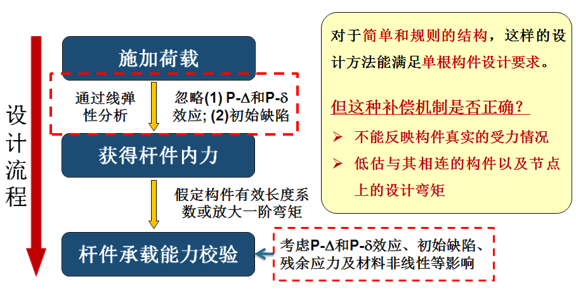
There are obvious problems:
- It cannot reflect the true force conditions of the members
- It underestimates the design moments of the connected members and the joints
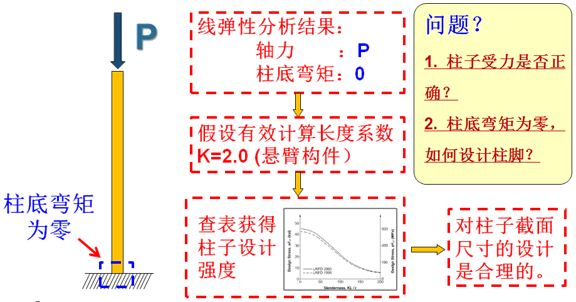
Example: A Cantilever Column Subjected Only to Axial Compression P
If the traditional linear elastic analysis method is adopted, and the design strength of the column is reduced through the effective length method, a reasonable column section design can be obtained. However: is the true force analysis of the column correct? The moment at the column base is zero, so how should the column base be designed?
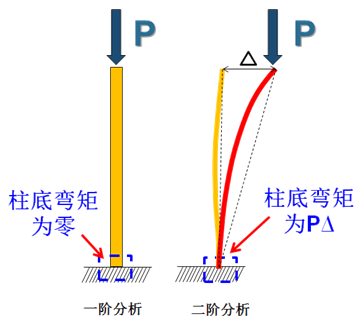
According to second-order analysis, the true moment at the column base should include the second-order moment, as shown in the figure below:
Other Deficiencies of the Effective Length Method
- In real structures, the effective length factor K is often difficult to determine
- The contribution of lateral-resistance components such as bracing to lateral stiffness is difficult to incorporate
- It assumes that all members buckle simultaneously
In real structures, the effective length factor K is often difficult to determine
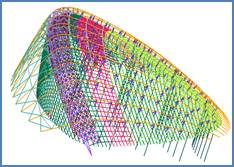
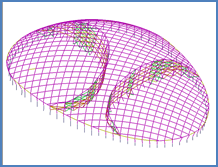
For the complex spatial reticulated shell below, how can the effective length of each member be clearly determined?
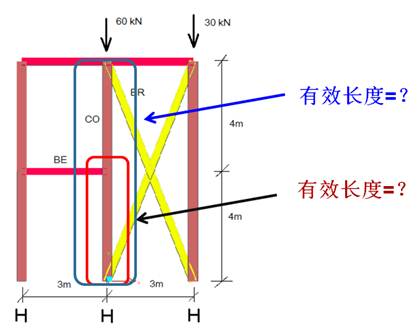
The contribution of lateral-resistance components such as bracing to lateral stiffness is difficult to incorporate
According to the formulas provided in the codes, the contribution of components such as bracing to lateral stiffness is generally ignored.
Assumption that all members buckle simultaneously
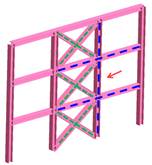
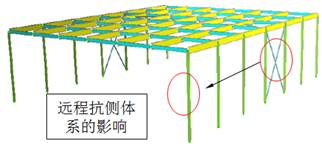
For the conventional structure below, it is impossible for all columns to buckle simultaneously:
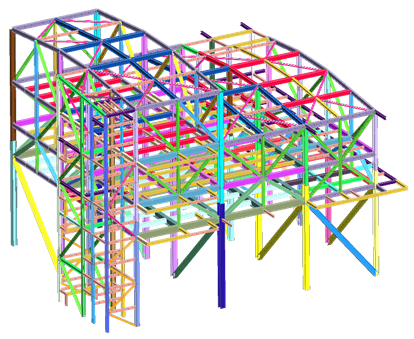
Therefore, in practical applications, the traditional linear elastic analysis method has many limitations and encounters difficulties even with many ordinary structures, let alone complex structural systems, and is even more helpless for tensile systems.