What is the Column Stability Problem
Concepts of Stable and Unstable Equilibrium
The most basic criterion for judging stability:
A structure is in an equilibrium position under load, and a small external disturbance causes it to deviate from the equilibrium position. When the disturbance is removed, if the structure can still return to the original equilibrium position, then the equilibrium state is stable; if the structure cannot return to the original equilibrium position and deviates further and further from the initial equilibrium position, then it is an unstable equilibrium.
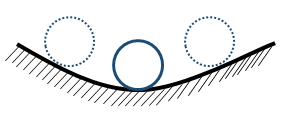
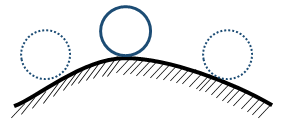
When the axial force on a column is less than the Euler critical load, the column is in a stable equilibrium state; when the axial force exceeds the Euler critical load, the column buckles past the stable equilibrium and reaches an unstable equilibrium state.
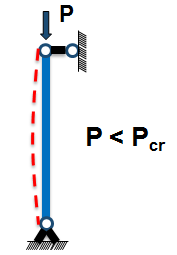
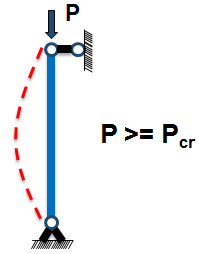
Determination of the Euler Critical Load
Generally expressed as:

Where: Pcr is the Euler critical load;

E is the elastic modulus; I is the section moment of inertia; L is the length of the member.
"Instability" at the Theoretical Level
The Euler critical load is an instability mode derived from theory, assuming that the member does not undergo any lateral deformation before reaching the critical load, until the axial force reaches the critical load, when it suddenly buckles.
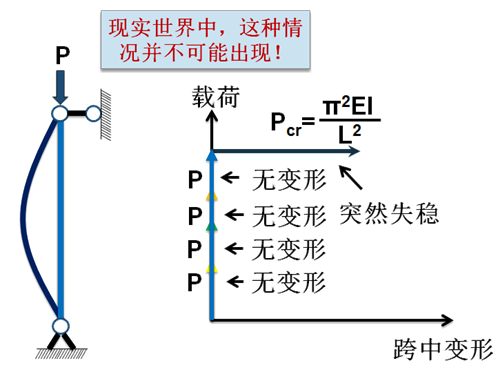
Member Imperfection
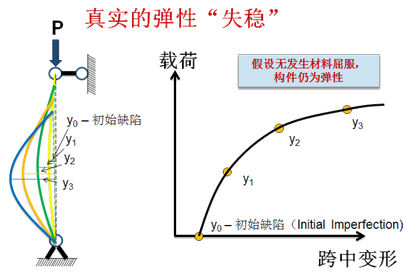
In reality, all members have initial curvature, also known as initial imperfections. In the real world, because members have initial imperfections, they already have initial curvature before being loaded, so under axial force, the lateral deformation continuously increases until a certain critical load is reached, when the axial force remains unchanged but the lateral displacement continues to increase, and the member undergoes unstable equilibrium failure.
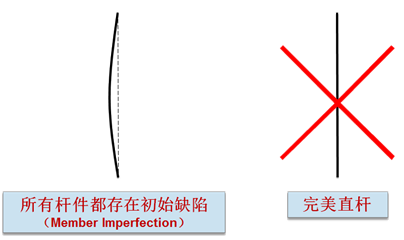
Correct Understanding of Column Stability
Due to the influence of initial imperfections, an axially loaded column begins to bend as soon as the load is applied. As the compression force continuously increases, the bending deformation also continuously increases, and the second-order bending of the column under axial force also continuously increases, until, while the compression force remains unchanged, the member deformation still continues to increase, at which point the member undergoes unstable equilibrium failure.