Introduction to Second-Order (Direct) Analysis Method
The second-order analysis method (direct analysis method, advanced analysis) is a system-level global analysis method based on nonlinear analysis theory, aimed at reflecting the true response of the structural system. Because this method considers the P-Δ and P-δ effects of the structure, as well as the global system and local member initial imperfections, it can accurately reflect the structural stress and stability conditions. This method does not require frame classification, assumption of member effective length, or amplification of member end moments, making the design process simple, efficient and reliable, requiring only section capacity check. This method has successively appeared in major steel structure design codes worldwide, and is gradually becoming the preferred method. For example, in the American AISC-2010 code, the direct analysis method is formally written into the main chapter, Chapter C, of the new AISC code, preceding the traditional linear analysis method. Today, major consulting firms have adopted the second-order analysis method, which has been widely applied in many major engineering projects. This method will gradually replace the traditional linear elastic design method and become the mainstream of structural design.
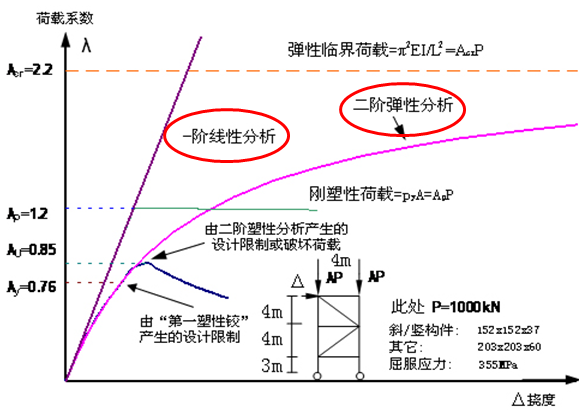
Analysis Characteristics
- System-level global analysis method based on nonlinear theory
- Considers the P-Δ and P-δ effects of the structure
- Considers global system imperfections
- Considers local member initial imperfections
- Considers member residual stresses and material elastoplasticity
- Member design requires only section capacity check
System-Level Global Analysis Method Based on Nonlinear Theory
It considers the influence of structural deformation on equilibrium, and its equilibrium equation is established on the deformed configuration, which is fundamentally different from the first-order linear analysis that does not consider the influence of deformation on equilibrium; this has been proposed in research for decades, and in the last decade or so, with the updates of codes in various countries, it has been widely applied, showing a trend of gradually replacing the traditional linear analysis method; the rapid development of computer hardware and software and internet technology has laid the foundation for the widespread application of the second-order analysis method.
However, some structural design software claims to have second-order analysis and design capabilities. The following compares true second-order analysis method with the "second-order analysis" method often claimed by software, as shown below:
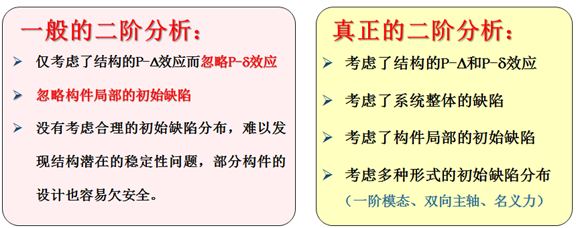
Therefore, when selecting software, it is necessary to understand whether the software truly has second-order analysis capability.
Considers the P-Δ and P-δ Effects of the Structure
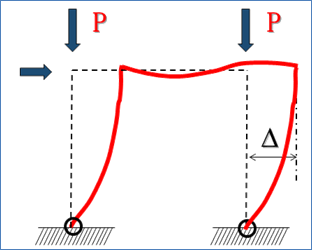
P-Δ Effect: Structure Effect
Under the combined action of lateral loads and vertical loads, the system node displacements and vertical loads will produce additional moments, called P-Δ moments.
P-δ Effect: Member Effect
Under the combined action of moments and axial forces, the member deformation produces additional moments, called P-δ moments.
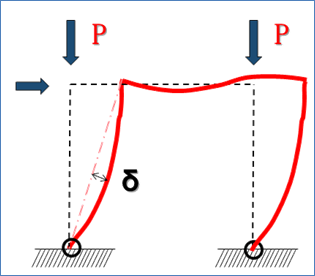
For slender members, such as columns with large slenderness ratios, braces, etc., special attention should be paid to the P-δ effect.
Considers Global System Initial Imperfections
To consider factors such as construction deviations and overall initial tilting that exist in actual structures, the influence of global imperfections needs to be taken into account during the analysis process.
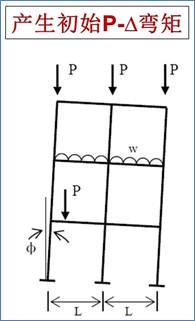
Considers Local Member Initial Imperfections
To consider the initial curvature that exists in actual members, the influence of member initial imperfections needs to be taken into account during the analysis process.
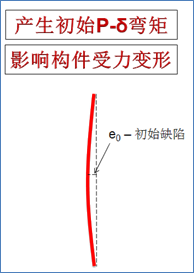
Member initial imperfections play a crucial role in obtaining correct design internal forces, member deformation, and identifying potential stability problems. A true second-order analysis (direct analysis) must consider member initial imperfections!
Considers Member Residual Stresses and Material Elastoplasticity
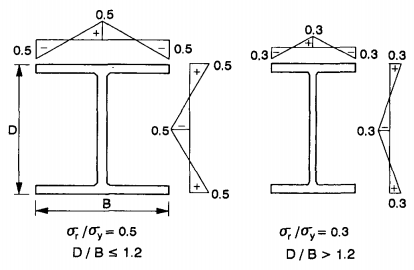
Residual Stress
Refers to the internal stresses generated during the member processing, but under different processing techniques, such as cold bending, hot rolling, or welding, the corresponding residual stress values also differ. For example, the design residual stress distribution diagram for hot-rolled I-sections given by ECCS.
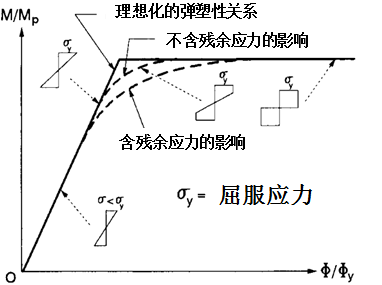
Material Yielding
Refers to the situation when the member bears a load beyond the elastic limit, where part of the section enters the elastoplastic stage, and plastic spreading occurs along the member length. For example, the moment-curvature relationship curve of an I-section.
Stiffness Reduction
To consider the influence of member residual stresses and material elastoplasticity, in the second-order analysis method, the bending stiffness EI and axial compression stiffness EA of members will be reduced. The reduction factors are obtained according to relevant codes.
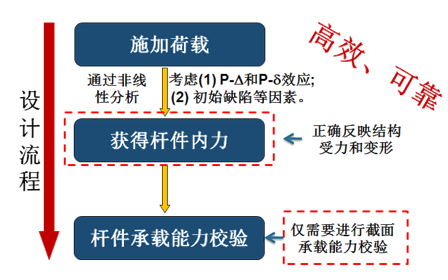
Summary: Second-Order (Direct) Analysis Method Design Workflow
The second-order direct analysis method, by considering real factors such as geometric nonlinearity, material nonlinearity, and initial imperfections, establishes equilibrium equations on the deformed configuration to directly solve for the true structural response, ultimately requiring only section capacity check, eliminating the cumbersome effective length assumptions and member end moment amplification steps in the traditional method, making the design safer, more efficient, and more reliable.