New Trends in Structural Design
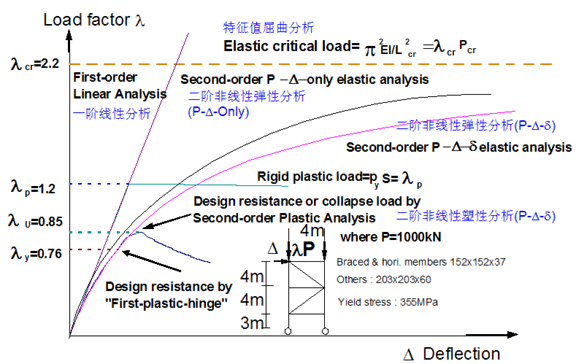
In steel structure design, global and local stability has always been a core consideration, and is particularly important for large slenderness ratio and complex spatial structural systems. The traditional Effective Length Method used to consider the buckling behaviour of compression members has a long history, but this method requires engineers to assume the effective length or factor of members, which has been widely debated in both practical engineering and scientific research. The traditional first-order linear analysis method cannot reflect the true structural response, especially in predicting the overall stability of the structure. Nowadays, design codes in many countries and regions strictly limit the application of linear design methods. For example, the new American code AISC-2010 imposes strict application conditions on the linear analysis method, applicable only to simple and regular structures; the Eurocode-3 (2005) stipulates that structures with an elastic critical coefficient less than 3 cannot be designed using linear analysis, and so on.
Structural forms are becoming increasingly novel and complex - how should the effective length be determined?
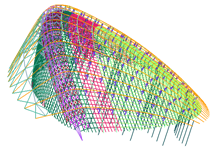
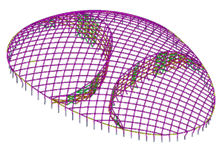
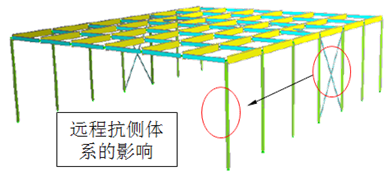
The second-order analysis method (direct analysis method, advanced analysis) is a system-level global analysis method based on nonlinear analysis theory, aimed at reflecting the true structural response of the system. Because this method considers the P-Δ and P-δ effects of the structure, as well as the global system and local member initial imperfections, it can accurately reflect the structural stress and stability conditions.
This method does not require frame classification, assumption of member effective length, or amplification of member end moments, making the design process simple, efficient and reliable, requiring only section capacity check. This method has successively appeared in major steel structure design codes worldwide, and is gradually becoming the preferred method. For example, in the American AISC-2010 code, the direct analysis method is formally written into the main chapter, Chapter C, of the new AISC code, preceding the traditional linear analysis method.
Today, major consulting firms have adopted the second-order analysis method, which has been widely applied in many major engineering projects. This method will gradually replace the traditional linear elastic design method and become the mainstream of structural design.